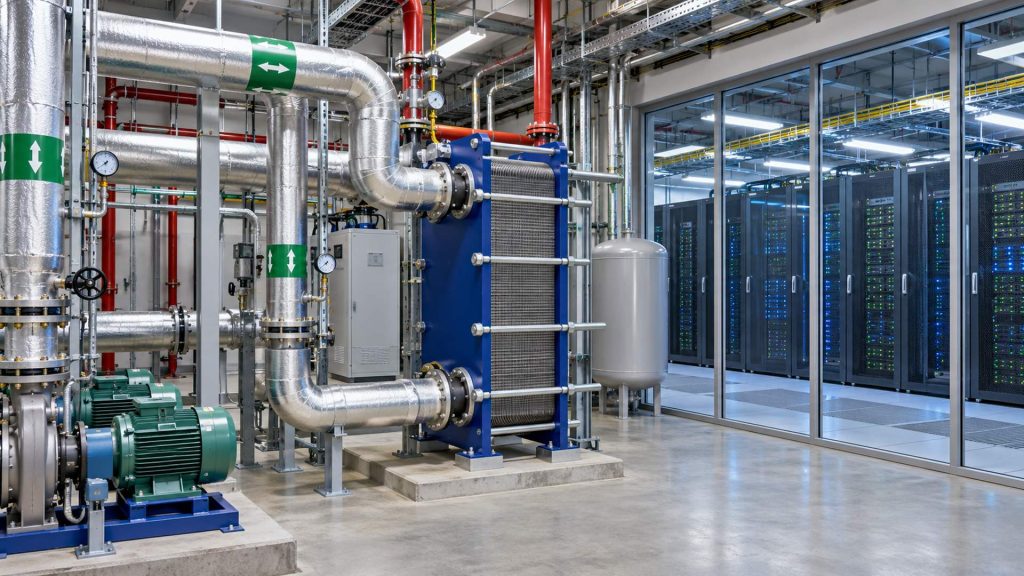
Data centre heat reuse can turn a cooling byproduct into useful heating, provided there is a suitable customer. The first questions are practical: who needs the heat, at what temperature, and when? A successful project connects those needs to the cooling system while protecting reliable computing operations.
Find the heat customer before fixing the design
Server equipment produces heat, but a nearby building does not automatically become a viable customer. A project needs to understand the customer’s heating system, operating calendar and alternative heat supply. A university, industrial site or district heating network may have different requirements even when each is physically close.
This energy review on Ariel Malik’s website examines that interface. For Australian projects, the local demand profile matters more than an example from a colder climate. A potential customer with year-round hot-water demand deserves a different assessment from a building that mainly needs space heating during a short winter.
Temperature matters as much as quantity
The U.S. Department of Energy’s data centre design guide identifies a nearby heat user and suitable infrastructure as important considerations. Heat at the temperature available from a cooling circuit may not be suitable for direct use. A heat exchanger separates circuits; a heat pump may be needed to raise the temperature to the customer’s requirement.
Oak Ridge National Laboratory has studied high-temperature heat pumps for recovering heat from its Frontier computing facility. That work illustrates an engineering pathway rather than a universal return on investment. For a new proposal, the team should identify actual supply and return temperatures, seasonal variation and the electricity needed to deliver useful heat.
Draw the boundary around the complete system
A heat recovery unit creates several interfaces: the data centre cooling loop, the transfer equipment, any connecting pipework and the customer’s heating plant. Each interface needs a clear operating limit and a responsible party. The project should also identify which organisation can change settings and how changes are communicated.
Consider a simple planning scenario. The heat customer closes for maintenance while computing continues. Where does the heat go? The data centre needs an appropriate independent cooling arrangement, and its capacity should be assessed for that condition. An assumed heat sale cannot become the only route for removing heat from critical equipment.
Questions to settle before procurement
- What useful temperature and flow does the customer require?
- How much demand overlaps with the available heat?
- What extra electricity do pumps and heat pumps consume?
- Who owns, maintains and meters the connecting assets?
- What happens when either party is unavailable?
- How will delivered performance be accepted and reported?
These questions can be answered progressively. An early feasibility study can document uncertainty without pretending that every design detail is settled. The important step is to separate measured data, engineering assumptions and commercial expectations so that each can be reviewed.
Measure heat that actually displaces another source
Recovered heat and useful delivered heat are different accounting quantities. Losses, temperature requirements and periods without a customer can affect the final result. A measurement plan should define where energy is recorded and how auxiliary electricity is allocated, rather than relying on an equipment nameplate.
The environmental assessment also needs a stated comparison. Which heating source would otherwise operate, and what electricity supplies the recovery equipment? A claim about avoided emissions should use that boundary and disclose its assumptions. Without it, two projects may publish figures that appear comparable but represent different services.
Build an operating agreement alongside the pipework
The commercial arrangement should explain availability, maintenance windows, metering and responsibility for interruptions. A customer may want dependable heat at specific hours, while the data centre prioritises cooling resilience. Those requirements need an agreed interface rather than an expectation that the engineering team will resolve them after commissioning.
Site selection can make the opportunity easier or harder. Connection distance, access routes and future building plans should therefore enter the discussion early. This complements the site’s reviews of storage procurement and local energy infrastructure: the useful service, its location and its operating constraints shape the value of the technology.
Start with a matched-demand study
A sensible first deliverable is an hourly comparison of available heat and customer demand, accompanied by a preliminary temperature assessment. The team can then compare direct recovery, heat-pump-assisted recovery and continuing with separate systems, using the same service requirements.
Heat reuse deserves attention where that comparison supports it. Before choosing equipment, ask for a clear account of who will use the heat and what they will receive. Explore the other energy reviews on this site for more discussions of the relationship between technology, infrastructure and practical delivery.
